

Someone you love just got a devastating diagnosis. Suddenly, you’re a caregiver.
It’s not because you applied for the job. It’s because someone needs you and you’re showing up.
In the last two weeks, I’ve watched this play out with multiple family members in the hospital. I’ve seen partners, siblings, and parents shift into caregiver mode without warning. I’ve watched people cancel plans. They rearrange their lives. They run on nothing but adrenaline and whatever caffeinated beverage is keeping them upright.
And I’ve heard the same well-meaning advice over and over: “Make sure you take care of yourself too.”
As if you have time. As if it’s that simple. As if you’re not already running on fumes, guilt, and whatever’s left of your caffeinated beverage.
When I Needed Care
I know what this looks like because I’ve been on both sides of it. I was sick and in and out of the hospital. Then, they finally diagnosed me and I got an amputation. And my 20-something son became a caregiver overnight. He moved back home to help out. He was a natural at it. The home care nurses visited multiple times a week. They loved him and worked with him. They showed him how to do things when they weren’t around because he genuinely wanted to learn.
But even as grateful as I was, I worried about him. I didn’t want him to be burdened. I didn’t want caregiving to take over his life. Not when he should be out doing crazy twenty-something things (while, of course, making good choices…).
That’s the thing about caregiving. It’s not just hard on the person doing it. It’s hard on the person receiving care, who sees what it costs.
Which is why the advice to ‘take care of yourself’ feels so hollow.
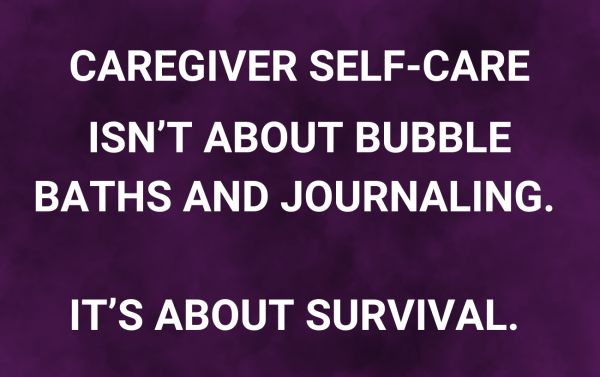
Caregiver self-care isn’t about bubble baths and journaling. It’s about survival. And it’s a lot harder than anyone wants to admit.
The Guilt Is Real (And It’s Lying to You)
If you feel guilty taking care of yourself while someone you love is suffering, you’re not alone. That guilt is loud, and it’s convincing.
But it’s also wrong.
Taking a break doesn’t mean you care less. Eating a meal doesn’t mean you’re selfish. Asking for help doesn’t mean you’re failing. You can’t pour from an empty cup. More importantly, you’re a human being who deserves to exist outside of crisis mode.
The guilt will tell you otherwise. Ignore it.
“Self-Care” That Actually Fits Into Caregiving
Forget the Instagram version of self-care. You don’t need a spa day or a meditation retreat (though if someone wants to fund that, great!). You need things that are small, realistic, and won’t make you feel worse for doing them.
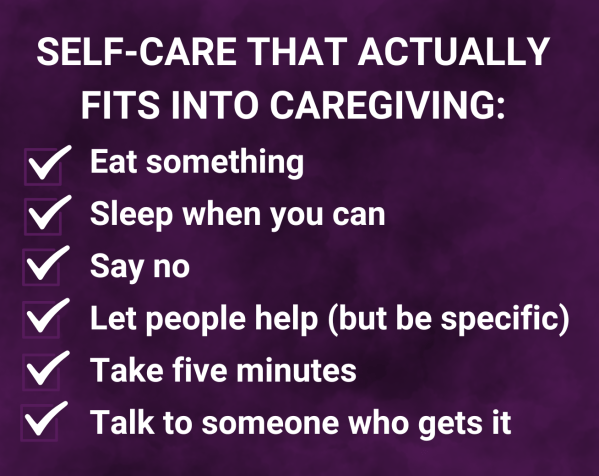
Eat something.
Not later. Not when you have time. Now. Even if it’s not a “real meal.” Protein bars, leftovers, whatever. Your body needs fuel. Spite only gets you so far.
Sleep when you can.
Not eight perfect hours. Just sleep. In the car. On the couch. In a hospital chair. Wherever. Sleep deprivation makes everything harder.
Say no.
You don’t have to update everyone. You don’t have to host. You don’t have to be “on” for people who aren’t directly helping. Protect your energy like it’s the limited resource it is.
Let people help (but be specific).
“Let me know if you need anything” is kind but useless. If someone offers, tell them exactly what you need. Ask them to pick up groceries. Have them sit with your person for an hour. Request they bring dinner. They could walk the dog. Make it easy for them to actually help.
Take five minutes.
Sit in your car. Step outside. Close the bathroom door and breathe. Five minutes won’t fix everything, but it might keep you from completely losing it.
Talk to someone who gets it.
Not someone who wants to fix it or tell you it’ll be fine. Someone who will just listen (quietly) and not make you feel like you have to perform gratitude or optimism.
What Caregivers Actually Need
(That No One Talks About)
Permission to feel everything.
You’re allowed to be scared, angry, exhausted, and resentful, all at the same time. You’re allowed to love someone and also hate what’s happening. Those feelings don’t make you a bad person. They make you human.
Acknowledgment that this is hard.
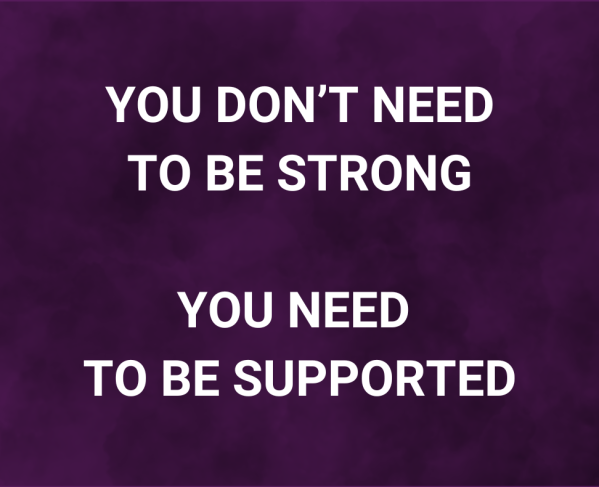
Not “you’re so strong” or “I could never do what you’re doing.” Just that this is really, really hard. You don’t need to be strong. You need to be supported.
A break that doesn’t come with guilt.
You need time away. Not because you don’t care, but because caregiving is relentless and you will break if you don’t step back occasionally. That’s not weakness. That’s reality.
Flexibility.
Plans will change. Appointments will run long. Emergencies will happen. You need people in your life who understand that and don’t make you feel bad about it.
To not be the strong one for five minutes.
You’re holding it together for everyone else. You need someone who will hold it together for you.
When Self-Care Feels Impossible, Do This
Some days, self-care isn’t going to happen. You’re in the hospital. You’re fielding calls. You’re managing medications and insurance and a thousand other things. On those days, the goal isn’t thriving. It’s surviving.
Survival self-care looks like:
- Drinking water
- Taking your own medications (if you have them)
- Sitting down for two minutes
- Letting something slide that doesn’t actually matter
- Accepting that today was hard and tomorrow might be, too
That’s enough. You are enough.
You Didn’t Sign Up for This, But Here You Are
Caregiving isn’t something most people choose. It’s something that happens, and you do it because someone you love needs you. That doesn’t make it easy. It doesn’t make it fair. And it doesn’t mean you have to do it perfectly.
You’re allowed to struggle. You’re allowed to need help. You’re allowed to take care of yourself, even when it feels impossible.
Because if you don’t, you won’t be able to keep showing up.
And the people who love you (including the person you’re caring for) need you to survive this, too.
 Up Down Walk with Lisa