
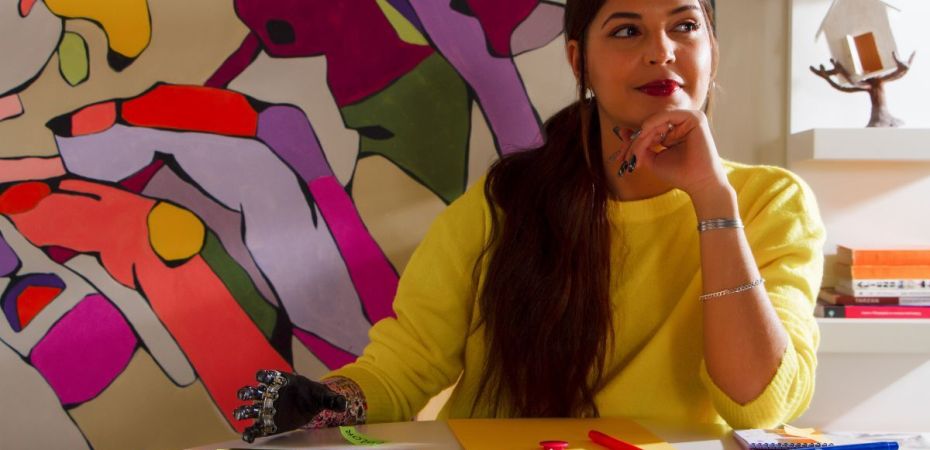
Lol! Oh, that’s a serious question? Uh…Ok…
Answer: Because when you see us, you get used to us. And when you get used to us, you stop staring. And when you stop staring, you start seeing us as…people.
When you see people with limb loss and limb differences in everyday life, over and over, the “shock” starts to go away. We just start to become part of the background of what “normal” looks like. Which is the whole point.
Because the goal is not for strangers to stare harder.
The goal is for strangers to stop acting like our bodies are a museum display.
The Bridgerton example that made me pause
In the most recent season of Bridgerton, there’s a maid with a limb difference. Part of her arm is missing.
And here’s what I loved about it: she wasn’t a “very special episode.” She wasn’t a tragic backstory. She wasn’t there so any of the other characters could learn a lesson.
She had a name. She did her job. People spoke to her like she was… a person.
Nobody said, “Can I get that for you?” every five seconds.
Nobody referred to her as “the maid with the missing arm.”
They just called her by her name, like you do when you’re not being weird.
That kind of representation matters because it’s not asking for applause, not asking for special favors. It’s the kind of representation that shows how disability is just another part of life, not a disruption to it.
The moment in The Pitt that felt real
Yes, I’ve mentioned this before. BECAUSE I LOVE IT.
There’s a scene in the last episode of the first season of The Pitt where one of the doctors takes off his prosthetic leg at the end of a shift, and then he rubs his stump. He’s tired, he’s been on it all day, it makes sense.
And nobody turns it into a spectacle.
No dramatic music. No crowd gathering. No interrogation.
One of the new doctors may clock it and does a quick mental “oh,” but the vibe is basically: okay, anyway.
That’s what normal looks like.
And normal is powerful.
Why “normal” works
When disability only shows up on screen as tragedy, inspiration, or a plot device, it teaches people to treat disabled bodies like they’re not actually real people.
But when disability shows up as ordinary, then it teaches:
- People with limb differences have jobs (shocking, I know)
- We have relationships (turns out people like us)
- We’re in scenes that have NOTHING to do with our bodies (wild concept…)
- We don’t need a backstory to exist in a room (neither do you)
Representation doesn’t have to be loud to be meaningful. Sometimes it’s meaningful because it’s quiet.
A personal note, because I’m not above a little hypocricy
I didn’t notice how many people with limb loss and limb differences were out in the world until I became one of them.
And I want more of that on screen. Not because I want pity, but because familiarity is how the world catches up.
If you work in media, healthcare, or basically anywhere with influence
Here’s the ask: Put disabled people in the room. Cast us. Write us. Not as the point, just as people.
At some point, I want the world to see a guy with a prosthetic and think, “Oh, that’s Eric.”
Not “Eric, the guy missing a limb.”
Just Eric.
If you’ve seen a show or movie that handled limb difference well (or handled it terribly), tell me. I’m collecting examples, because that’s now one of my hobbies.
And if you’re someone who’s new to limb loss or limb difference, welcome!
You’re not alone. Thank you for existing.
 Up Down Walk with Lisa